Show results for
Explore
In Stock
Artists
Actors
Authors
Format
Condition
Theme
Genre
Rated
Label
Specialty
Decades
Size
Color
Deals
- Featured Books
- New Release Books
- Featured Collectibles
- Youtooz
- Alex Warren sale
- Frankenstein Wolf Man Legacy Collections
- Deal Grabber
- Deal Grabber-Action
- Deal Grabber-Anime
- Deal Grabber-Horror Scifi
- Deal Grabber-TV
- Deal Grabber Music
- $9.99 and Under Music Sale
- $9.99 and Under Movies Sale
- 50%-69% off Music Sale
- 50%-69% off Movies Sale
- 25th Anniversary Films and TV
- 4K Ultra HD Sale
- 88 Films
- Abkco Label Sale
- Accept on sale
- Acorn Media
- Ad Icon
- Adventure Time
- Agatha Christie
- Alabama Shakes sale
- Alien Fan Shop
- Alliance Authentic
- AMC RLJ Studio
- Animals ABKCO sale
- Anime Collectibles
- Anime Toys
- anthrax sale
- Apparel Accessories
- Aquaman
- Aquarius
- Arhoolie records
- Arrow Video on sale
- Attack on Titan
- Audio Technica
- Audiobooks
- Avatar Air Bender Fan Shop
- Avatar Fan Shop
- Avatar The Last Air Bender
- axe heaven
- Back to the Future Fan Shop
- Bandai Collectible Figures
- Banned Books
- Banpresto
- Barbie Fan Shop
- Batman Day
- Bear Family Records Sale
- Beartooth on sale
- Beast Kingdom
- Beatles Music on Sale
- Beetlejuice
- Believe Label Sale
- Big Fudge Sale
- Billy Strings on sale
- Bionik
- Black Panther
- Blokees
- Blowout Bin
- Blowout Bin Games Button
- Blue Elan Records Sale
- Blue Underground
- Blues New Release Blues Sale
- Bluescentric
- Bluetooth Headphones
- Bluetooth Speakers and Components
- Bluetooth Turntables
- Blu-ray and 4K Buy More Save More Sale
- Blu-ray Audio sale
- Board Games
- Bob's Burgers
- Bonobo sale
- deep book blowout bin
- Books Art and Photography
- Books Best Sellers
- Books Box Sets
- Books by Genre Button
- Books Childrens
- Books Coming Soon
- Books Contemporary Fiction
- Books Manga
- Books New Releases
- Books Nonfiction
- Books that Rock
- Borderlands Fan Shop
- Bravado
- Bridgerton Fan Shop
- Broadway Cast Recordings Sale
- deep business and politics books
- Carly Pearce sale
- deep cellar live label sale
- Chainsaw Man
- Charley Label Sale
- Chronicle Books
- Classic Albums For Your Collection
- Classical New Release Sale
- Cleopatra Label Special Sale
- Cleopatra Records sale
- Cohen Media Group
- comedy sale
- Compuexpert
- Country New Release Sale
- Country Sale
- CP pre order
- Criterion Collection
- Criterion Collection Sale
- Crunchyroll
- daddario
- Daphyls
- Dark Crystal
- Dark Horse
- Dark Horse Comics Collectibles
- DC Comics
- DC Premiere
- Deadpool X Men Fan shop
- Deadpool X Men Fan Shop
- Deep Discount 25th Anniversary Music sale
- deep funko cartoon blitz
- Funko Gold Series
- deep funko pins
- deep gpo electronics
- deep hasbro games shop
- deep hasbro star wars vintage
- deep puzzle shop
- deep spider man fan shop
- Demon Slayer
- Dexys Midnight Runners sale
- Digicom
- Disney
- Doctor Who
- Downton Abbey
- Dragon Ball
- Drama Sale
- Dreamgear on sale
- Dreamworks Sale
- Dune Fan Shop
- Dungeons and Dragons
- Earbuds
- Eddie Van Halen Guitar Replicas
- Edifier Speaker Sale
- Educational Activities label sale
- Elvis Presley Fan Shop
- Emphasis Label Sale
- empire distribution label sale
- Engelbert Humperdinck sale
- Epitaph sale
- Eureka Classics
- Everlast Sale
- Exclusive Bundles
- Factory Entertainment
- Fallout Fan Shop
- Fan Favorites
- Fan Favorites Music Sale
- Fantastic Four Fan Shop
- Featured Vinyl
- FiGPiN
- Film Collectibles
- Film History Books
- Fisher Price
- Fitness Accessories
- Fitness Accessories
- Five Nights at Freddys Fan Shop
- Flotsam & Jetsam on sale
- Frank Zappa Sale
- Friends Fan Shop
- Frozen Culture
- Fun City Editions
- Funko Action Figures
- Funko Apparel
- Funko Bitty Pop
- Funko Cartoons
- Funko Comic Book
- Funko Directors and Icons
- Funko Fusion
- Funko Minis
- Funko Pop N Buddy
- deep retro toys funko
- Funko Rocks
- deep funko soda
- Funko Urban
- Funko Video Game
- Furyu
- Game of Thrones Sale
- deep games blowout bin
- Gentle Giant Label Sale
- Gerry Beckley sale
- Ghostbusters
- GI Joe Fan Shop
- Giant Vintage, T-Shirts, band shirts, vintage,
- Gmerch
- Godzilla
- Golden Age of Hollywood
- Golden Girls
- Good Smile Company
- Good Time Inc Sale
- Corgi Sale
- Grand Theft Auto VI
- Great Eastern Entertainment
- Green Lantern fan shop
- Grindhouse Releasing
- Guardians of the Galaxy
- Hachette
- Hallmark
- Halo Fan Shop
- Handmade by Robots
- Hard to Find Music
- Hardcover Books
- Harmonia Mundi Sale
- Harry Potter Books
- Harry Potter Universe
- Hasbro Marvel Legends Collectibles Sale
- deep hasbro shop
- Hasbro Transformers Studio Series
- HBO Specials
- Headphones
- Hindsight Records
- Hispanic Heritage Month Film Sale
- Hispanic Heritage month music sale
- Hit Films Sale
- Hiya Toys
- Hocus Pocus
- Holiday Collectibles
- Hori Nintendo
- Horror Collectibles
- Horror Collectibles
- How to Train Your Dragon
- ICUP
- Import Music Sale
- Indiana Jones Fan Shop
- Inner Knot Label Sale
- Insights Editions
- Interpol sale
- ION Audio sale
- Iron Studios
- It Pennywise Fan Shop
- Jada toys
- James Bond Fan Shop
- Jazz New Release Sale
- Jensen on sale
- Jethro Tull Music Sale
- John Coltrane sale
- Journals
- Joytoy
- JSP Records Sale
- Jujutsu Kaisen
- Jurassic Park Fan Shop
- JVC Headphones
- Kamelot on sale
- Kanto Speakers Sale
- Kanto Super Sale
- Kidrobot
- Kit Parker
- Klanggalerie Label sale
- Klaus Nomi Sale
- Kotobukiya
- KPop Sale
- Latin New Release Sale
- Lava Lamps
- LEGO
- Lightyear Video
- Deep Lilo and Stitch Fan Shop
- Lion King Fan Shop
- Little Buddy Super Mario
- Little Mermaid Fan Shop
- little people Fisher Price
- Loki Fan Shop
- Looney Tunes Fan Shop
- Loungefly
- Loyal Subjects
- Lucy Sale
- mc records label sale
- Madden NFL on sale
- Made In Germany Label Sales
- Magic the Gathering
- Manic Merch
- Marvel
- Marvel Venom
- Mascot Records Sale
- Master Replicas
- Masters Of Music Sale
- Masters of the Universe
- Mastodon Sale
- Matrix
- Mattel
- Mattel Barbie
- Mattel Games
- Mattel Hotwheels
- Mattel Toys
- Maxell Audio
- McFarlane Toys
- Medicom
- Mega Brands
- Megahouse
- Mego toys
- Merrithew Fitness
- Metal Gear Solid Master Collection Vol 2
- Metal New Release Sale
- micky dolenz sale
- Mighty Jaxx
- Mill Creek Entertainment
- Minecraft Shop
- MNRK Label on sale
- Moana Fan Shop
- Monogram
- Monster High Fan Shop
- Monty Python
- Mortal Kombat
- Mugs and Cups
- music collectibles
- Musicals Sale
- deep mvd rewind
- My Arcade
- My Hero Academia
- Napalm Records Sale
- Naruto
- Natalie Imbruglia sale
- Naxos Label Sale
- NBA Fan Shop
- Neca
- Needles and Cartridges
- Neil Gaiman
- Neil Young sale
- Nemesis Now
- Netflix Fan Shop
- New Release Video Games
- New Releases
- Nightmare Before Christmas
- Nintendo Switch Games
- NOFX sale
- numskull
- Olive Films
- One Piece Fan Shop
- Orange Rouge
- Overwatch
- Paladone
- Paperback Books
- paramount presents
- Paris Paloma sale
- Peanuts Fan Shop
- Peppa Pig
- Perri's Corp
- Persona
- Pixies on sale
- Planet Waves
- Playmobil Sale
- PlayStation Games
- Pokemon
- Pop Culture Home and Office
- POPFUN
- Power Rangers
- Powerhouse Films
- Prime 3D
- Prince Music Sale
- Pyramid Home Decor and Accessories
- Quantum Mechanix
- Quarto Books Sale
- R&B sale
- Rap and Hip Hop New releases
- Rap and Hip Hop Sale
- RE Zero
- Redeye Distribution Sale
- Refurbished Video Games
- Reissued Sounds Vinyl
- Religion and Spirituality
- Renaissance Label Sale
- Resident Evil Fan Shop
- Resonance A Plague Tale Legacy
- Retro VHS
- Rhythm Bomb Records Sale
- Rick and Morty
- Rock Candy Records
- Rock New Release Sale
- Rocksax
- Rolling Stones ABKCO sale
- Ronin Flix Films
- Room Copenhagen
- Sam Cooke ABKCO sale
- Sandpiper
- Sanrio Fan Shop
- Scooby Doo
- Scream Factory
- Scream Fan Shop
- Scream Films
- Sega
- Seinfeld
- Sepia Records Sale
- deep sesame street fan shop
- Severin
- Shang Chi Fan Shop
- SHM-CD sale
- Shout Factory
- Shout Select
- Shudder Studio
- Silent Films Sale
- Singing Machine
- Smithsonian Folkway sale
- Smithsonian Folkways Sale
- Smithsonian Folkways Special Collection
- Son Volt sale
- sonic the hedgehog
- Sony Blues and Jazz on Sale
- Sony Classical on Sale
- sony latin sale
- Sony Rock and Pop Sale
- Sony Soul
- Sony Soundtracks on Sale
- Sony Vinyl on Sale
- soul asylum sale
- Soul R+B new release sale
- Sound Pollution Records Sale
- Soundtracks New Release Sale
- South Park Fan Shop
- Speakers and Components
- SpongeBob Squarepants Fan Shop
- Sports Collectibles
- Star Trek
- deep star trek special
- Star Wars Funko
- Star Wars on Sale
- Star Wars Zero Company
- Steelbook Films and TV
- Stephen King
- Stephen King IT fan shop
- Storm Collectibles
- Stranger Things
- Studebaker
- Studio Ghibli
- Studio Quiver Film
- Studio Sportlight VCI Video
- Studio Spotlight Altered Innocence
- Studio Spotlight Amcomri
- Studio Spotlight Arrow
- Studio Spotlight Bleiberg Entertainment
- Studio Spotlight Blue Underground
- Studio Spotlight Cheezy Flicks
- Studio Spotlight Cult Epics
- Studio Spotlight Decal Releasing
- Studio Spotlight Electric Entertainment
- Studio Spotlight Filmrise
- Studio Spotlight Full Moon
- Studio Spotlight Kit Parker Films
- Studio Spotlight Liberator Films
- Studio Spotlight MVD Film Masters
- Studio Spotlight MVD Rewind
- Studio Spotlight MVD SRS Cinema
- Studio Spotlight Powerhouse Films
- Studio Spotlight Radiance
- Studio Spotlight Smore Entertainment
- Studio Spotlight Troma
- Studio Spotlight Unearthed Films
- Studio Spotlight Visual Vengeance
- Studio Spotlight Wild Eye Releasing
- Sundance IFC Studio
- Sunset Blvd Label Sale
- Super Mario Brothers Fan Shop
- Super7
- Superman Fan Shop
- Supernatural
- Symphonic Label Sale
- Synapse Films
- Tabletop Games
- Tamagotchi
- Tamashii Nations
- Taschen Books
- The Addams Family
- The Blood of the Dawnwalker
- The Boys Fan Shop
- The Jayhawks sale
- the mandalorian deep sale
- The Mini Axe
- The Muffs sale
- The Simpsons Fan Shop
- The Smurfs Fan Shop
- The Umbrella Academy
- The Walking Dead
- Threezero
- Thundercats fan shop
- TinyTan Collectibles
- Titan Entertainment
- TMNT Fan Shop
- Tokyopop
- Tolkien
- Toy Story Fan Shop
- Trails in the Sky 2nd Chapter
- Transformer Fan Shop
- trapeze label sale
- Trick or Treat Studios
- Tubbz
- Turntables
- Turtle Beach
- Turtle Beach Sale
- TV Buy More Save More Sale
- TV Collectibles
- TV Favorites Funko Collectibles
- Twin Peaks
- UFO on sale
- ultraman
- Universal Monsters
- universal music best sellers sale
- Universal Specials
- VCI Sale
- Vertical Entertainment
- Vestron Video
- Victrola Sale
- Video Bundles
- Video Game Collectibles
- Video Game Deals
- Video Game Merch
- Video Game Plush Collectibles
- Video Game Soundtracks
- Vinegar Syndrome
- Vinyl Accessories
- Vinyl Accessories Sale
- vinyl sale
- Vinyl Styl
- Warhammer Fan Shop
- Warner Archive
- Warner Bros Specials
- Warner Classics
- Watchmen
- Western Jubilee label sale
- Western Sale
- Westworld
- Weta Workshop
- Wicked Fan Shop
- Willow Fan Shop
- Winning Moves
- Witcher
- Wonder Woman
- deep wonder woman
- WWE
- Blu-ray 3D Movies Sale
- XBox Games
- Yellowstone
- Yep Roc Label sale
- Studio Spotlight Classicflix
- Studio Spotlight Gravitas Ventures
- Studio Spotlight Voltage Films
- Studio Spotlight-BBC
- Studio Spotlight-Cinedigm
- Studio Spotlight Dreamworks
- Studio Spotlight Focus Features
- Studio Spotlight-HBO
- Studio Spotlight-House Lights
- Studio Spotlight-Kino
- Studio Spotlight-Lionsgate
- Studio Spotlight MGM
- Studio Spotlight-MHZ
- Studio Spotlight-Mill Creek
- Studio Spotlight-Music Box
- Studio Spotlight-NCircle
- Studio Spotlight New Line
- Studio Spotlight-OCN Digital Distribution
- Studio Spotlight-Olive Films
- Studio Spotlight-Oscilloscope
- Studio Spotlight-Paramount
- Studio Spotlight-PBS
- Studio Spotlight-RLJ
- Studio Spotlight-Severin
- Studio Spotlight-Shout Factory
- Studio Spotlight-Sony
- Studio Spotlight-Synapse
- Studio Spotlight-The Film Detective
- Studio Spotlight-Universal
- Studio Spotlight Viz
- Studio Spotlight Warner Bros
- Studio Spotlight-Well Go Entertainment
- Z2 Comics
- Z2 Comics
- Zee Productions

Chopin & Schubert: Cello Sonatas
- (Steven Isserlis)
- Format: CD
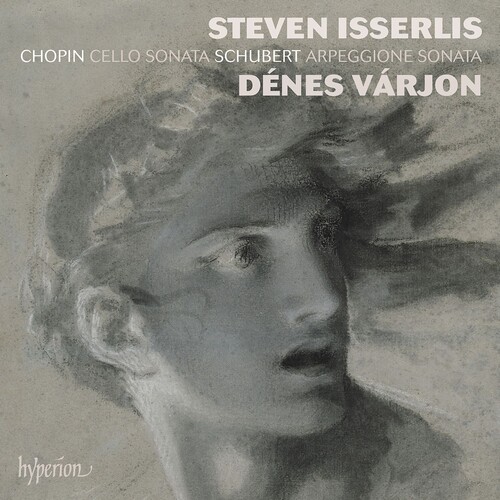
Chopin & Schubert: Cello Sonatas
- Artist: Steven Isserlis
- Format: CD

Description
Chopin & Schubert: Cello Sonatas on CD
Schubert and Chopin—two men of genius who had much in common: ultimately tragic figures who both died in their thirties, the last few years of their lives spent under the constant shadow of death; both miraculously inventive; both masters of smaller forms, through which they transformed musical genres—in Schubert’s case that of song, in Chopin’s that of piano music; and both possessed of a gift for melody that has won them places deep in the hearts of music lovers. On the other hand, they were in so many ways utterly different: Schubert an unworldly, untidy Bohemian who never enjoyed true worldly success, was not a great performer, but mastered most musical forms; Chopin a fastidious dandy who set sartorial as well as musical fashions ablaze in Paris, was practically worshipped as a virtuoso pianist, but never even attempted to compose a work not featuring his chosen instrument. One wonders how—or if—they would have related to each other had they ever met.
Well, they never did meet; but they might have done so, had Schubert not died in Vienna in late 1828, at the unpardonably early age of thirty-one. Within a year of that catastrophic event, the nineteen-year-old Chopin was taking the great city by storm, the Viennese music establishment stunned and fascinated by this exotic talent from Poland—‘a light flashing across our musical horizon like a brilliant meteor’, as one reviewer put it. Later that year, while staying at the Polish palace (a ‘paradise’, according to Chopin) of Prince Radziwiłł, an amateur cellist who had known Beethoven and Goethe and was to be the dedicatee of Chopin’s piano trio, Chopin wrote his Polonaise brillante for piano and cello as a gift for the Prince and his pretty pianist daughter, Princess Wanda. Chopin’s much-quoted letter to a friend, written shortly afterwards, in which he dismissed the polonaise as ‘nothing more than a brilliant drawing-room piece suitable for the ladies’ should not be taken too seriously. It is probably just a self-deprecating squib typical of the composer’s modesty; and furthermore it should be remembered that, at the time of that letter, he had not yet written the expressive introduction (which was added for a concert in Warsaw the following year)—or even, it would seem, the cello’s triumphant closing theme (track 2, 4'32) which hastens the work towards its exuberant conclusion. At any rate, since he later performed the work in Poland, and even considered it worthy of the effort of a solo piano transcription (rediscovered only in the 1980s), I think we may presume that, despite his dismissive words, he was fond of the piece. Understandably so: with its alluring blend of refined charm, energy and beauty, it is (in this writer’s humble opinion) a winner.
On a return visit to Vienna in 1831—having left Poland for the last time—Chopin encountered the Austrian cellist and composer Joseph Merk, who had been a friend of Schubert’s. ‘He is the only cellist I respect’, wrote Chopin at the time. When the Introduction and Polonaise brillante was published in Vienna later that year, it bore a dedication to Merk. Moving on to Paris, however—destined to be his home for the rest of his life—Chopin met, through their mutual friend Liszt, a second cellist whom he could respect: Auguste Franchomme. Before long Franchomme, a quiet, kind-hearted man (‘the good Franchomme’, as Chopin sometimes described him), was to become Chopin’s musical partner, close confidant, and—not to put too fine a point upon it—general dogsbody. Chopin, highly critical though he was of most other composers, thought highly enough of Franchomme’s compositional talents to collaborate with him, in 1833, on a Grand Duo concertant for cello and piano based on themes from Meyerbeer’s Robert le Diable. (Collaborative compositions of this sort were not unusual: for instance, in 1830 Merk had jointly composed a set of variations for cello and piano with Mendelssohn.) Franchomme, in addition to arranging as many as fifty of Chopin’s works for cello, also composed much music of his own. A taste of his compositional style can be gleaned from the little gem presented here, the first of three nocturnes published in 1838. It seems particularly apt for inclusion on this album in that, while the outer sections clearly betray Chopin’s influence, the middle section sounds decidedly Schubertian. It also provides a gentle transition between the high-spirited youthful Chopin of the polonaise and the darkly ruminating, inward-looking Chopin of the late cello sonata.
This sonata, by far the most important of Chopin’s chamber works and the last piece of his to be published during his lifetime, has not had an easy history. Ever since its first appearance, some listeners have been disturbed by its complex tonal language and emotional volatility. Few could deny, however, that it is a major statement, wrought from the depth of Chopin’s musical soul. Chopin seems to have had the sonata in mind from 1844 at least; late that September, he announced to his lover (or at least companion), the writer George Sand, that he was to ‘try through some sonatas with Franchomme’ (I wonder which sonatas?). But it would seem that work on his own sonata did not begin in earnest until the summer of 1845, which he spent at Sand’s country house in Nohant. ‘I am in some strange world … an imaginary space’, Chopin wrote tellingly to his family around that time. At first, the sonata did not seem to cause undue problems. By the end of the year, he had played some of it through with Franchomme—to whom the work is dedicated—and seemed quite satisfied. ‘It goes well. I don’t know whether I’ll have time to have it printed this year’, he wrote carelessly. Alas, it was not to be that simple. A year later, he wrote, again to his family: ‘Sometimes I am satisfied with my cello sonata, sometimes not. I throw it into the corner, then pick it up again.’ The mass of surviving sketches—enough to fill a whole volume—tell their own story. One can all too easily imagine Chopin’s state of mind as he toiled at the sonata from Sand’s description of his struggles with an earlier composition: ‘He shut himself up in his room for whole days, weeping, walking about, breaking his quills, repeating or altering a bar a hundred times, writing it down and erasing it as often, and starting over the next day with a scrupulous and desperate perseverance. He would spend six weeks on one page, only to return to it and write it just as he had on the first draft.’
The sonata was essentially completed in February 1847, although further changes were still to be made after he and Franchomme performed it privately for friends during the following months. It was sold to the publishers Breitkopf & Härtel in June, and published in October of that year. The first public performance would be given by Chopin and (of course) Franchomme at Chopin’s final appearance in Paris, at the Salle Pleyel, on 16 February 1848. This was by all accounts an extraordinary occasion—one of those moments in musical history which one might well choose to attend when time travel finally becomes available at an affordable price. Perhaps using the word ‘public’ to describe this famous concert is a little misleading, however. There were only three hundred (very expensive) tickets available, so Chopin knew that the hall would be exclusively occupied by ‘the beautiful Parisian society’—including many of those society ladies who the next year would ‘consider it their duty to faint’ in Chopin’s room as he lay dying. The organizers made sure that only Chopin’s closest friends would be in his eye-line as he played, on a stage bedecked with flowers. Chopin’s contributions to the evening were a Mozart trio with the violinist Delphin Alard and Franchomme, several solos—and the second, third and fourth movements of the cello sonata.
So why was the opening movement omitted? Well, the official—and probably correct—explanation was that when Franchomme and Chopin had played the sonata through to their friends, the reaction to the first movement had been, for the most part, perplexity; the themes seemed to be too numerous, the textures too complex, for the listeners to comprehend. But another rather intriguing theory has also been put forward. By the time of this concert, Chopin and Sand had sundered in spectacularly hostile fashion, after a long period of unhappiness. It was a rupture that would never be repaired, one from which Chopin seems never to have recovered. His health declined steadily from this point, and his homesickness for Poland—now an unattainable dream—increased painfully. Perhaps deliberately (but it is only a possibility), the main theme of the sonata’s opening movement bears a certain resemblance to the first song of Schubert’s Winterreise, ‘Gute Nacht’: ‘A stranger I came, a stranger I depart.’ The whole cycle describes the sad fate of one who, cast out by his lover, wanders the world in a state of icy despair. Might Chopin have known Winterreise, identified with this state of being, and deliberately quoted from the song? And might he have shrunk, under the circumstances, from performing such a deeply confessional work in public? Fanciful, perhaps; but it is true that George Sand loved the music of Schubert, and that Chopin’s Parisian publisher was steadily introducing Schubert’s music to the French musical world, so that seems possible, at least. And as a hypothesis, it is both interesting and particularly appropriate for this recording.
At any rate, the first movement of the sonata is an extraordinary creation, ballade-like in its sense of narrative, convoluted and intricate in texture. There are four main themes (initially heard at 0'20; from 1'04; from 2'38; and from 4'02), all of which share one striking characteristic: each begins lyrically, before growing to a passionate conclusion. It is almost as if Chopin is seeking to confound those who liked to pigeonhole him as composer of salon miniatures with a work of unquestioned strength and virility. This extreme contrast within every theme also results in an enigmatic blend of withdrawn introversion and heroic defiance. The dotted rhythms unmistakably convey this latter quality; often a symbol of royalty in earlier music, here they seem (to me, anyway) to represent uniquely Polish pride.
The other movements may be a little easier to take in on first hearing, but they are no less original. The scherzo, recalling the Polish dances so close to Chopin’s heart, packs a swiftly varying kaleidoscope of moods—from strutting valour to rhetorical challenge to disarming tenderness—into its small frame; while at its centre, the ‘trio’ section, almost berceuse-like, contains one of Chopin’s loveliest melodies (at 2'00). The slow movement provides a haven of peace and beauty, before the finale returns us brusquely to the conflicts of the opening movement. Here the heroic opening subject is juxtaposed (at 1'04) with a sparse, lonely-sounding second theme, followed in turn by the dance-like third subject (from 1'49). All three themes feature the dotted rhythms familiar from the first movement; but at the return of the second theme (at 3'37), those dotted rhythms are absent—a poignant omission. Is there a specific story behind this sonata? I cannot say; but I feel strongly that both personal and national sadness are woven into its narrative. Perhaps the energy of the finale’s coda could mislead us into believing that we are approaching a triumphant conclusion. But no; with the penultimate gesture of the work, an unmistakably tragic C minor chord, Chopin informs us in no uncertain terms that this a far-from-joyous farewell.
And so to Schubert. The arpeggione—also known as the cello-guitar—was/is a curious instrument invented by the Viennese guitar luthier Georg Staufer, and championed by Schubert’s friend Vincent Schuster, who composed for the instrument and wrote a manual advising budding arpeggionists how to master the unusual beast. The arpeggione had frets, like a guitar, but was bowed, and held between the knees—hence the title ‘cello-guitar’. The sound was thin and plaintive, rather like a viola da gamba; it is not surprising that the instrument quickly faded into obscurity. A sole concerto written in 1823 by the legendary H A Birnbach (I know—I’ve never heard of him either) is lost; and the arpeggione would probably be forgotten today had it not been for Schubert’s act of friendship in writing this sonata for Schuster.
Perhaps, though, it was not merely friendship that prompted Schubert to undertake this commercially unpromising project. The arpeggione is essentially a forlorn, introvert instrument; these qualities may have suited Schubert’s mood perfectly as he approached the sonata. It was written in late 1824, some two years into the illness that was to overcloud the last few years of Schubert’s short life, and only a few months after he had written the following heart-rending words to a friend: ‘I may well sing every day now, for each night when I go to bed I hope never to wake again, and each morning tells me only of yesterday’s grief.’
I suppose that the sonata could, on the face of it, be seen as a light, entertaining work, full as it is of Schubertian charm; but underneath that alluring surface, there is surely a work of immense, if understated, sadness. Well, each interpreter and listener will—must—have his or her own view of the work. Unquestionable, at any rate, is that the first movement is a thoroughly characteristic blend of song-like melody and dance rhythms, full of the subtly ambiguous touches that are such a hallmark of Schubert’s genius. To take but one example: in the coda (from 10'50), Schubert brings back one of the earlier lilting dance-themes, but at half tempo; it is as if the heart has gone out of the dance, the dancer, abandoned, still sadly swaying by himself in the darkened ballroom.
The slow movement, a true song without words, is in E major—perhaps not coincidentally the key Schubert chose for the heavenly slow movement of his string quintet in C major. While the music stays within the home key’s embrace, the atmosphere seems warm, comforting; but an icy presence seems to threaten whenever we stray into foreign tonalities. Again, as the short movement nears its close, the tempo halves, with desolate effect. An improvisatory bridge-passage on the arpeggione/cello leads us into the last movement, whose opening subject, set firmly in the tonic major, seems at first to presage a joyous finale. The second and third main themes (at 1'24 and 4'00), offering gypsy passion and Viennese grace respectively, also begin with the promise of good things; but all three subjects end somehow in sighs, the principal subject in particular accruing further poignant ornaments at each return. The whole gives the impression—as so often in Schubert—that yes, life goes on in all its beauty; but the composer himself is increasingly an outcast, forlornly looking in at his friends’ celebrations from outside the window. It has often been said of Schubert’s music that it smiles through tears; for me, it is perhaps more accurate to say that it sheds tears as it smiles.
Finally the songs: as a rule, I avoid playing lieder on the cello, because my feeling is that the poems are usually such an integral part of the composition that their absence diminishes the music. However, in the case of Chopin’s Nie ma czego trzeba (composed in 1845—though it is a reworking of an earlier song, Dumka, from 1840—and published posthumously as No 13 of the Op 74 collection of Polish songs) the words, again about one cast out for ever from home and love, are so unremittingly tragic that perhaps the austere beauty of the music is best heard without such specific connotations. I cannot, however, use such an excuse for playing Schubert’s Nacht und Träume. Here the words, by Matthäus von Collin (1779-1824) and describing the radiance of dreams and the comfort of night, are beautiful in their own right—and of course perfectly incorporated into the music. But when several years ago a friend brought me this song, saying that he thought it would work perfectly on the cello, what choice did I have but to fall in love on first sound? Blame my friend. Blame Schubert, for his unique ability to transport us, within a few notes, to heaven.
