Show results for
Explore
In Stock
Artists
Actors
Authors
Format
Condition
Theme
Genre
Rated
Label
Specialty
Decades
Size
Color
Deals
- Featured Books
- New Release Books
- Featured Collectibles
- Youtooz
- Juice Newton sale
- Deal Grabber
- Deal Grabber-Action
- Deal Grabber-Anime
- Deal Grabber-Horror Scifi
- Deal Grabber-TV
- Deal Grabber Music
- $9.99 and Under Music Sale
- $9.99 and Under Movies Sale
- 50%-69% off Music Sale
- 50%-69% off Movies Sale
- 250th America Sale
- 25th Anniversary Films and TV
- 4K Ultra HD Sale
- 50s Film and TV Sale
- 50s music sale
- 88 Films
- Abkco Label Sale
- Acorn Media
- action adventure
- Ad Icon
- Adventure Time
- Agatha Christie
- Alice Cooper on sale
- Alien Fan Shop
- Alliance Authentic
- Allison Russell sale
- AMC RLJ Studio
- Animals ABKCO sale
- Anime Collectibles
- Anime Toys
- Apparel Accessories
- Aquaman
- Arhoolie records
- Arrow Films Sale
- Arrow Video on sale
- Assassins Creed Black Flag
- Attack on Titan
- Audio Technica
- Audiobooks
- Avatar Air Bender Fan Shop
- Avatar Fan Shop
- Avatar The Last Air Bender
- deep axe heaven
- Back to the Future Fan Shop
- Bandai Collectible Figures
- Banned Books
- Banpresto
- Barbie Fan Shop
- Batman Day
- BBC Sale
- Bear Family Records Sale
- Beast Kingdom
- Beetlejuice
- Believe Label Sale
- Big Fudge Sale
- Bionik
- Black Panther
- Black Sabbath sale
- Blokees
- Blowout Bin
- Blowout Bin Games Button
- Blue Elan Records Sale
- Blue Underground
- Blues New Release Blues Sale
- Blues Sale
- Bluescentric
- Bluetooth Headphones
- Bluetooth Speakers and Components
- Bluetooth Turntables
- Blu-ray Audio sale
- Board Games
- Bob's Burgers
- deep book blowout bin
- Books Art and Photography
- Books Best Sellers
- Books Box Sets
- Books by Genre Button
- Books Childrens
- Books Coming Soon
- Books Contemporary Fiction
- Books Manga
- Books New Releases
- Books Nonfiction
- Books that Rock
- Borderlands Fan Shop
- Brantley Gilbert on Sale
- Bravado
- Bridgerton Fan Shop
- Bubble Puppy sale
- deep business and politics books
- deep cellar live label sale
- Chainsaw Man
- Charley Label Sale
- Charli XCX on sale
- Christmas in July Sale
- Chronicle Books
- Classic Albums For Your Collection
- Classical Music Sale
- Classical New Release Sale
- Cleopatra Records sale
- Cohen Media Group
- Compuexpert
- Coro 25th anniversary sale
- Country New Release Sale
- Country Sale
- CP pre order
- Criterion Collection
- Crunchyroll
- Cypress Hill sale
- daddario
- Daphyls
- Dark Crystal
- Dark Horse
- Dark Horse Comics Collectibles
- David Bowie sale
- DC Comics
- DC Premiere
- Deadpool X Men Fan shop
- Deadpool X Men Fan Shop
- deep all star wars world
- Deep Discount 25th Anniversary Music sale
- deep funko cartoon blitz
- Funko Gold Series
- deep funko pins
- deep gpo electronics
- deep hasbro games shop
- deep hasbro star wars vintage
- deep puzzle shop
- deep spider man fan shop
- Demon Slayer
- Devil Driver on sale
- Digicom
- Disney
- Doctor Who
- Downton Abbey
- Dragon Ball
- Dreamgear on sale
- Dreamworks Sale
- Dune Fan Shop
- Dungeons and Dragons
- EA College Football 27
- Earbuds
- Eddie Van Halen Guitar Replicas
- Edifier Speaker Sale
- Educational Activities label sale
- Elvis Presley Fan Shop
- empire distribution label sale
- Epitaph sale
- Eureka Classics
- Exclusive Bundles
- Extra Term Blixa Sounds sale
- Factory Entertainment
- Fallout Fan Shop
- Fan Favorites
- Fan Favorites Music Sale
- Fantastic Four Fan Shop
- Featured Vinyl
- FiGPiN
- Film Collectibles
- Film History Books
- Fisher Price
- Fitness Accessories
- Fitness Accessories
- Five Nights at Freddys Fan Shop
- Flamin' Groovies sale
- Folk Music Sale
- Foreigner sale
- Friends Fan Shop
- Frozen Culture
- Fun City Editions
- Funko Action Figures
- Funko Apparel
- Funko Bitty Pop
- Funko Cartoons
- Funko Comic Book
- Funko Directors and Icons
- Funko Fusion
- Funko Minis
- Funko Pop N Buddy
- deep retro toys funko
- Funko Rocks
- funko shield through the ages
- deep funko soda
- Funko Urban
- Funko Video Game
- Furyu
- Game of Thrones Sale
- deep games blowout bin
- Gemini Sound sale
- Gentle Giant Label Sale
- Gen-X Music Sale
- Ghostbusters
- GI Joe Fan Shop
- Giant Vintage, T-Shirts, band shirts, vintage,
- Gmerch
- Godzilla
- Golden Girls
- Goo Goo Dolls on sale
- Good Smile Company
- Good Time Inc Sale
- Gracie Abrams sale
- Grand Theft Auto VI
- Grateful Dead sale
- Great Eastern Entertainment
- Greatest Hits Sale
- Grindhouse Releasing
- Guardians of the Galaxy
- Hachette
- Hallmark
- Halo Fan Shop
- Handmade by Robots
- Hard to Find Music
- Hardcover Books
- Harmonia Mundi Sale
- Harry Potter Books
- Harry Potter Universe
- Hasbro Marvel Legends Collectibles Sale
- deep hasbro shop
- Hasbro Transformers Studio Series
- HBO Specials
- Headphones
- Heated Rivalry Pre-order
- Hindsight Records
- Hiya Toys
- Hocus Pocus
- Holiday Collectibles
- Hori Nintendo
- deep horror buy more save more
- Horror Collectibles
- Horror Collectibles
- Houndmouth sale
- How to Train Your Dragon
- Indiana Jones Fan Shop
- Inner Knot Label Sale
- Insights Editions
- ION Audio sale
- Iron Studios
- It Pennywise Fan Shop
- jack white sale
- Jada toys
- James Bond Fan Shop
- Jazz New Release Sale
- Jensen on sale
- Jerry Lee Lewis sale
- Johnny Cash Music on Sale
- Journals
- JSP Records Sale
- Jujutsu Kaisen
- Jurassic Park Fan Shop
- JVC Headphones
- Kanto Speakers Sale
- Kanto Super Sale
- Kidrobot
- Klanggalerie Label sale
- Kotobukiya
- KPop Sale
- L.A. Guns on sale
- Latin New Release Sale
- Lava Lamps
- LEGO
- Lenny Kaye sale
- Lex Records sale
- Lightyear Video
- Deep Lilo and Stitch Fan Shop
- Lion King Fan Shop
- Little Buddy Super Mario
- Little Mermaid Fan Shop
- little people Fisher Price
- Loki Fan Shop
- Looney Tunes Fan Shop
- Loungefly
- Loyal Subjects
- mc records label sale
- Madden NFL on sale
- Made In Germany Label Sales
- Madonna sale
- Magic the Gathering
- Marvel
- Marvel Venom
- Mascot Records Sale
- Master Replicas
- Masters of the Universe
- Matrix
- Mattel
- Mattel Barbie
- Mattel Games
- Mattel Hotwheels
- Mattel Toys
- Maxell Audio
- McFarlane Toys
- Medicom
- Mega Brands
- Megahouse
- Mego toys
- Merrithew Fitness
- Metal and Rock Sale
- Metal New Release Sale
- MGM Sale
- Mighty Jaxx
- Mill Creek Entertainment
- Minecraft Shop
- MNRK Label on sale
- Moana Fan Shop
- Monogram
- Monster High Fan Shop
- Monty Python
- Moonspell sale
- Mortal Kombat
- Motionless in White sale
- Motley Crue sale
- Motorhead sale
- Mugs and Cups
- music collectibles
- My Arcade
- My Chemical Romance sale
- My Hero Academia
- Name is in the Title Sale
- Napalm Records Sale
- Naruto
- Naxos Label Sale
- NBA Fan Shop
- Neca
- Needles and Cartridges
- Neil Gaiman
- Nemesis Now
- Netflix Fan Shop
- New Order Sale
- New Release Video Games
- New Releases
- Nightmare Before Christmas
- Nintendo Switch Games
- numskull
- Olive Films
- One Piece Fan Shop
- Orange Rouge
- Overwatch
- Paperback Books
- paramount presents
- Peanuts Fan Shop
- Peppa Pig
- Perri's Corp
- Persona
- Planet Waves
- Playmobil Sale
- PlayStation Games
- Pokemon
- Pop Culture Home and Office
- Power Rangers
- Powerhouse Films
- Prime 3D
- Prince Music Sale
- Protest music sale
- Punch Brothers on sale
- Pyramid Home Decor and Accessories
- Quantum Mechanix
- Quarto Books Sale
- Rap and Hip Hop New releases
- RE Zero
- Redeye Distribution Sale
- Refurbished Video Games
- Reissued Sounds Vinyl
- Religion and Spirituality
- Renaissance Label Sale
- Reservoir Records Sale
- Rhythm Bomb Records Sale
- Rick and Morty
- Rick Ross sale
- Rock Candy Records
- Rock New Release Sale
- Rocksax
- Rolling Stones ABKCO sale
- Ronin Flix Films
- Room Copenhagen
- Ruf Records sale
- Sam Cooke ABKCO sale
- Sandpiper
- Sanrio Fan Shop
- Scream Factory
- Scream Fan Shop
- Scream Films
- Sega
- Seinfeld
- Self Titled Album Sale
- Sepia Records Sale
- deep sesame street fan shop
- Severin
- Shang Chi Fan Shop
- SHM-CD sale
- Shout Factory
- Shout Select
- Shudder Studio
- Simply Red sale
- Singing Machine
- Smithsonian Folkway sale
- Smithsonian Folkways Sale
- Smithsonian Folkways Special Collection
- S'more Entertainment Sale
- sonic the hedgehog
- Sony Blues and Jazz on Sale
- Sony Classical on Sale
- sony latin sale
- Sony Rock and Pop Sale
- Sony Soul
- Sony Soundtracks on Sale
- Sony Vinyl on Sale
- Soul R+B new release sale
- Sound Pollution Records Sale
- Soundtracks New Release Sale
- South Park Fan Shop
- Speakers and Components
- SpongeBob Squarepants Fan Shop
- Sports Collectibles
- Star Trek
- Star Wars Funko
- Star Wars on Sale
- Steelbook Films and TV
- Stephen King
- Stephen King IT fan shop
- Storm Collectibles
- Stranger Things
- Studebaker
- Studio Ghibli
- Studio Quiver Film
- Studio Sportlight VCI Video
- Studio Spotlight Altered Innocence
- Studio Spotlight Amcomri
- Studio Spotlight Arrow
- Studio Spotlight Bleiberg Entertainment
- Studio Spotlight Blue Underground
- Studio Spotlight Cheezy Flicks
- Studio Spotlight Cult Epics
- Studio Spotlight Decal Releasing
- Studio Spotlight Electric Entertainment
- Studio Spotlight Filmrise
- Studio Spotlight Full Moon
- Studio Spotlight Kit Parker Films
- Studio Spotlight Liberator Films
- Studio Spotlight MVD Film Masters
- Studio Spotlight MVD Rewind
- Studio Spotlight MVD SRS Cinema
- Studio Spotlight Powerhouse Films
- Studio Spotlight Radiance
- Studio Spotlight Smore Entertainment
- Studio Spotlight Troma
- Studio Spotlight Unearthed Films
- Studio Spotlight Visual Vengeance
- Studio Spotlight Wild Eye Releasing
- Sub Pop Sale
- Sun Ra Arkestra on sale
- Sundance IFC Studio
- Sunnyside Records Label sale
- Sunset Blvd Label Sale
- Super Mario Brothers Fan Shop
- Super7
- Superman Fan Shop
- Supernatural
- Synapse Films
- deep synapse films
- Tabletop Games
- Tamagotchi
- Tamashii Nations
- Taschen Books
- Tesla sale
- The Addams Family
- The Boys Fan Shop
- The Doobie Brothers on Sale
- the mandalorian deep sale
- The Menzingers sale
- The Mini Axe
- The Pet Shop Boys
- The Rolling Stones sale
- The Simpsons Fan Shop
- The Smurfs Fan Shop
- The Strokes sale
- The Umbrella Academy
- The Walking Dead
- Threezero
- Thundercats fan shop
- TinyTan Collectibles
- Titan Entertainment
- TMNT Fan Shop
- Together Again label sale
- Tokyopop
- Tolkien
- Tom Tom club sale
- Top Sellers Sale
- Toy Story Fan Shop
- Transformer Fan Shop
- trapeze label sale
- Trick or Treat Studios
- Tubbz
- Turntables
- Turtle Beach
- Turtle Beach Sale
- TV Collectibles
- TV Favorites Funko Collectibles
- TV Sale
- Twin Peaks
- UFC 6
- ultraman
- Universal Monsters
- universal music best sellers sale
- Universal Specials
- Vertical Entertainment
- Vestron Video
- Victrola Sale
- Video Bundles
- Video Game Collectibles
- Video Game Deals
- Video Game Merch
- Video Game Plush Collectibles
- Video Game Soundtracks
- Vinegar Syndrome
- Vinyl Accessories
- vinyl sale
- Vinyl Styl
- VP records label sale
- Warhammer Fan Shop
- Warner Archive
- Warner Bros Specials
- Warner Classics
- Watchmen
- Waterparks sale
- Western Jubilee label sale
- Westworld
- Weta Workshop
- Wicked Fan Shop
- Willow Fan Shop
- Winning Moves
- Witcher
- Wonder Woman
- deep wonder woman
- WWE
- Blu-ray 3D Movies Sale
- XBox Games
- Yellowstone
- Yep Roc Label sale
- Yes Sale
- Studio Spotlight Classicflix
- Studio Spotlight Gravitas Ventures
- Studio Spotlight Voltage Films
- Studio Spotlight-BBC
- Studio Spotlight-Cinedigm
- Studio Spotlight-Distribution Solutions
- Studio Spotlight Dreamworks
- Studio Spotlight Focus Features
- Studio Spotlight-HBO
- Studio Spotlight-House Lights
- Studio Spotlight-Kino
- Studio Spotlight-Lionsgate
- Studio Spotlight MGM
- Studio Spotlight-MHZ
- Studio Spotlight-Mill Creek
- Studio Spotlight-Music Box
- Studio Spotlight-NCircle
- Studio Spotlight New Line
- Studio Spotlight-OCN Digital Distribution
- Studio Spotlight-Olive Films
- Studio Spotlight-Oscilloscope
- Studio Spotlight-Paramount
- Studio Spotlight-PBS
- Studio Spotlight-RLJ
- Studio Spotlight-Section 23
- Studio Spotlight-Severin
- Studio Spotlight-Shout Factory
- Studio Spotlight-Sony
- Studio Spotlight-Synapse
- Studio Spotlight-The Film Detective
- Studio Spotlight Turner
- Studio Spotlight-Universal
- Studio Spotlight Viz
- Studio Spotlight Warner Bros
- Studio Spotlight-Well Go Entertainment
- Z2 Comics
- Z2 Comics
- Zee Productions

Songs of Connie Converse
- (Her Only Light)
- Format: CD
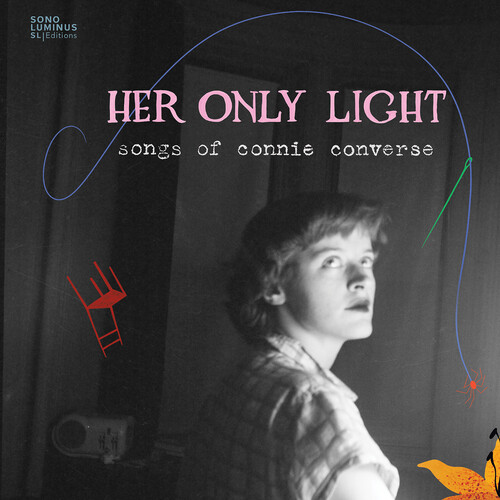
Songs of Connie Converse
- Artist: Her Only Light
- Format: CD

Future release: Item will ship as soon as it is available
Description
Songs of Connie Converse on CD
Evelyn Converse (Connie's mother):
Is it sweet little ditties or is it modernistic? Connie Converse: It's got everything in it. I'm the one in the smoky gray button-down, gently disentombing a viola from it's case in the gauzy, late morning light illuminating this inviting Northcenter studio. In the freelance Classical (and Classical-adjacent) world, projects and their attendant rehearsals encompass the vibes and caliber spectrum, but managing the contents of one's tear ducts is not generally a required qualification. Maybe you can try to get word to the violist, currently encamping himself and his stand beneath a towering harp. That unwitting sap-the one who at this moment only knows that the pieces he's playing were originally penned by someone with an enticingly alliterative moniker-has no idea that this music is about to occupy a good deal of the rent-free space available in his head and heart long after the live broadcast, the 'gig,' wraps. It is, I'm afraid, a decidedly common reaction to an oeuvre of unquestionably uncommon music for those that encounter it some seventy-plus years since it was meticulously penned. Whether this is your first orbit or you already count yourself amongst the members of the How Sad, How Lovely devout-Connie's modest and also astonishing kitchen table recordings, most recently reissued by her fellow Michiganders Third Man Records-the sounds currently spinning through your synapses here offer an entirely unique perspective of an artist who not only scooped Dylan on coaxing folk music from the universal to the personal by a literal decade, but indeed ventured into a territory of art song he will never quite access. Her Only Light is a more dimensional, more expansive view of Connie Converse, a composer-performer-pacifist-scholar-activist who, like the story of her enigmatic departure, deserves a telling beyond an easy headline. Some orientation is necessary, though. Elizabeth Eaton Converse was valedictorian of her high school, a scholarship recipient at Mount Holyoke College, a songwriting hopeful in Harlem, and the Co-Editor of the Journal of Conflict Resolution (Center for Research on Conflict Resolution) at the University of Michigan. Was she, as is editorialized about so many of my favorite creators, maybe a little too smart to be happy? A more accurate assessment arrives by way of her nephew Tim Converse, who generously shared with me, 'I think that she saw so clearly the way things should be that she was constantly disappointed by how things actually were.' This was certainly the case regarding her years in New York, having absconded early from Mount Holyoke to pursue her songwriting and singing aspirations. Consider that the 1950's Greenwich Village folk revival-in full swing as she composed-for all it's posturing about political revolution and working-class authenticity, was structurally about as progressive as a debutante ball. Add to that the fact the (then) recording industry's almost unshakable insistence on genre conformity and, in the case of female performers, sexual magnetism, and it doesn't take much to understand how a path-carving artist more engrossed in her compositional brilliance than her appearance failed to break through to the monoculture. Though history is of course littered with unrecognized genius, this was actually not precisely the case for Converse. She was featured on CBS's The Morning Show hosted by no less than Walter Cronkite, and was championed by animator Gene Dietch who, in addition to her own efforts, we have to thank for the recordings found on How Sad, How Lovely. At this inflection point, when she seemed poised to, well, make it, Connie Converse pivoted her writing toward a far less marketable but perhaps more adventurous corner of musicmaking: 'art song.' If Connie's 'Guitar Songs' (singer-songwriter, folk-oriented) were slow to gain traction, what hopes could her 'Piano Songs' (art song, harmonically enterprising) possibly have in such an inhospitable industry? Jesus. We're halfway through these liner notes and I haven't even introduced you to the two remarkable interpreters of said songs-the thoughtful Converse evangelists behind Her Only Light: arranger Ronnie Kuller and vocalist Emmy Bean. Almost immediately in that aforementioned rehearsal, which I should clarify was in service of a live performance on WFMT after this album was mixed and mastered, I was scheming how I might stay in proximity to Ronnie's dextrous, insightful writing and Emmy's lustrous, utterly persuasive phrasing in the years to come. Like so many generative collaborations, theirs originated in an abiding desire for connection and a fascination with the sublime. It was also a creative lifeboat in the not-so-distant era of prolonged home confinement. Sparked by Bean's sharing the 2015 Anna and Elizabeth cover of 'Father Neptune'-the harmonizing of which would provide inspiration for the arrangement here-with Kuller (who had already taken Converse's music up on stage while in residence at beloved Chicago venue The Hideout) the latter describes her decision-making process with unguarded enthusiasm: 'I want a harp. I want two clarinets at the same time. I want a string section! I want Emmy Bean to sing to me!' Ronnie goes on to share what I consider an essential reason why Her Only Light is so riveting and unmissable: 'When Emmy is singing, I believe every word.' Given that Connie is often credited with originating the singer-songwriter genre, one in which vulnerability evaporates any dramatic or emotional partition between singer and lyric, Converse's songs can only truly thrive when delivered with such tender veracity. As the duo explored Converse's art songs, transcribed by Kuller from the hand-written original scores, the desire for immersion in and dispersion of these songs only deepened. Emmy describes her 'forever memory' like this: 'Once we got started on the art songs we began with 'Song for Old Wars,' and I remember singing it for the first time in a big cavernous room on an old piano. This was a few weeks after Russia invaded Ukraine in 2022. Hearing the final cadence of that song echo in the room-the "horns"-was incredible. It gave me something to honor in all the chaos of new/old wars; I felt like Connie was with us, grieving the losses.' The other partition in need of a wrecking ball-one of primary importance to both singer and arranger-was that of folk song vs. Art song. Not only is this boundary a fanciful one perpetrated by hierarchically-minded (i.e. misled or confused) listeners and record industry execs originating from preconceptions about formal education, 'rigor,' and, to get right down to it, vibratoin the context of Connie Converse it results from the reality that her art songs, the 'Piano Songs,' never made it on tape during her own and Dietch's kitchen recording sessions. They were written later, and composed for voices other than her own, sometimes soprano, sometimes baritone. Emmy found herself slipping into Connie's world without friction, but decisions on how to stylistically inhabit the 'Guitar' and 'Piano' songs only revealed itself once the project was at full tilt: 'I was surprised to find how Connie's songs invite another singer into them. Some songs belong so intimately to their writer's voice (especially folk singers or singer-songwriters) that it feels wrong to sing them or hear them sung by others. When I took on this project, I was afraid that I wouldn't be able to find the access point, that I wouldn't be able to inhabit them, that I would find myself mimicking her or struggling to find myself in them. But the craft that Connie put into her art songs-the 'Cassandra Cycle,' 'anyone lived in a pretty how town,' etc-is also there in the songs she wrote on guitar. They are no less solid, no less fully realized than the ones she wrote on piano. They completely stand on their own, and they welcome any singer with the imagination and humility to hear them and be with them. The reward of singing them is to be inside of Connie's mind for a moment, to feel such great joy and such deep empathy, and to be able to smile at things that are so, so sad. I was also struggling to figure out how Connie's guitar songs and piano songs would exist together on the same record, in the same voice (mine). It wasn't until we got into the studio that Ronnie and I figured out that I could be the same singer throughout; there was no need to over-stylize the art songs or under-sing the folk songs. Together we were able to find an approach that honored the depth of her writing in both contexts, and that kind of broke the spell of genre over the whole thing.' As you traverse these Guitar Songs- 'Talkin Like You (Two Tall Mountains)' 'I Have Considered the Lillies' 'Father Neptune' 'One by One' and these Piano Songs- 'Vanity of the Vanities' 'The Rainmaker' 'Incommunicado' 'anyone lived in a pretty how town' (text by e.e. cummings) 'The Age of Noon' The Cassandra Cycle (excerpted) 'Cassandra's Entrance' 'Song for Old Wars' 'She Thinks of Heaven' 'She Devises a Lullaby' -relish as I do, if you will, Ronnie Kuller's orchestrational witticisms and delights, as with her leitmotif approach to 'Talkin Like You (Two Tall Mountains),' here and elsewhere gracious without unnecessary reverence or over-caution. Be carried off by Emmy Bean's sumptuous and entrancing delivery of 'Father Neptune,' but don't miss the cheeky wink in her voice as she alights on the song's more eyebrow-raising lines ('And it's still his creed that he has no need of a wifeexcept on shore'). Perhaps you're familiar with the melancholy pervasive in Converse's tunes, but her humor is equally nimble. And of course, don't disembark before you experience 'One by One,' the song currently making the hapless gigger unprofessionally bleary-eyed in the middle of a rehearsal. Loneliness has found it's most crystalline, most desolate voice in these verses, and to these ears at least, it is a one-of-one. That quote at the top of the page? It arrives by way of a recorded conversation between Connie and her mother concerning an in-processopera! This heroine of songwriting contained multitudes-a conclusion you are funneling toward as you make your way through this enchanting tracklist-and with Her Only Light, we are finally provided Connie Converse in full, resplendent resolution. -Doyle Armbrust